December 20, 2025
Understand share of voice, why it matters for your brand, and how AI tools like Clipbook help you measure and grow it.
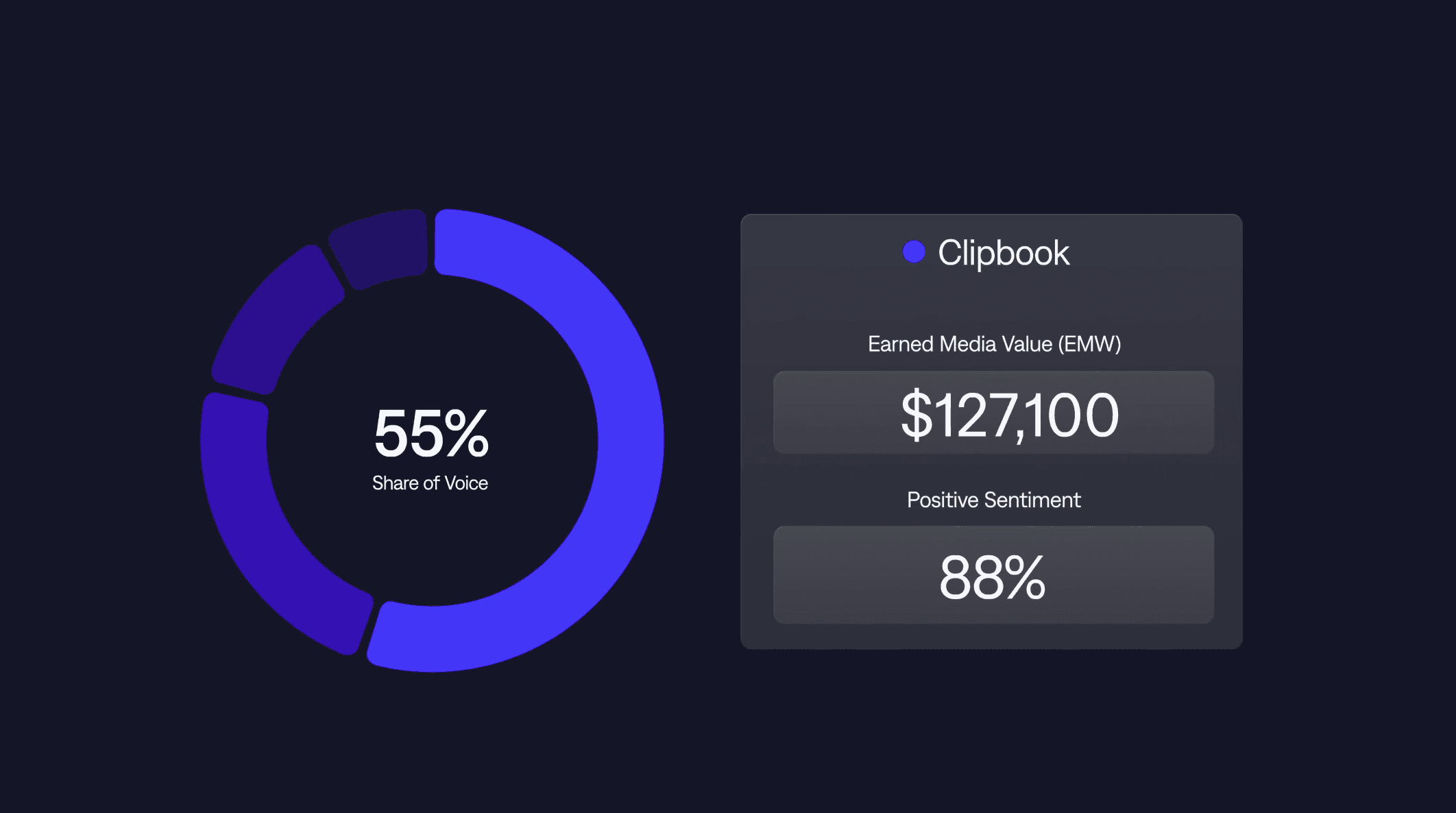



Share of Voice (SOV) is a critical metric that measures your brand's visibility in the marketplace compared to your competitors. It's a measure of how much of the conversation you own across various channels, including earned media, social media, advertising, and search. With the 2026 media landscape more fragmented than ever, tracking SOV is essential for PR and communications teams to gauge brand awareness, measure campaign effectiveness, and make strategic decisions.
What is Share of Voice?
Share of Voice (SOV) is a key performance indicator (KPI) that represents your brand’s portion of the conversation within your industry. It’s a powerful way to benchmark your brand's visibility against that of your competitors. While it originated in advertising to measure a brand's share of total ad placements, its meaning has expanded significantly in the digital age.
Today, SOV can be measured across a wide range of channels, including:
Earned Media: Mentions in news articles, TV and radio broadcasts, and podcasts.
Social Media: Mentions, hashtags, and engagement on platforms like X (formerly Twitter), LinkedIn, and Instagram.
Search Engines: Your brand's visibility in organic search results for relevant keywords (often called Share of Search").
Paid Advertising: Your brand’s share of impressions or clicks in a given market.
It’s important not to confuse Share of Voice with market share. Market share measures the percentage of total sales a brand has in a particular market. While a higher SOV often correlates with a higher market share, SOV is a measure of visibility and conversation, not revenue. For PR and communications professionals, SOV is a more direct and actionable indicator of their efforts' impact on brand awareness and perception.
Share of Voice Formula and Calculation
The fundamental formula for calculating Share of Voice is straightforward:
SOV = (Your Brand's Metrics / Total Market Metrics) x 100
The complexity lies in defining and gathering the "metrics." The specific data points you use will depend on the channels you are measuring. Let's break down the calculation for different channels:
Earned Media / PR SOV
For PR professionals, this is often the most important SOV calculation. It measures your brand's presence in news articles, press releases, and broadcast media compared to your competitors.
Your Brand's Metrics: The number of mentions your brand receives across relevant media outlets.
Total Market Metrics: The total number of mentions for your brand plus all your competitors.
Example: If your brand was mentioned 100 times in a month and your three main competitors were mentioned 150, 100, and 50 times respectively, the total market mentions would be 400 (100 + 150 + 100 + 50). Your SOV would be (100 / 400) x 100 = 25%.
Social Media SOV
This calculation helps you understand how much of the social media conversation in your industry revolves around your brand.
Your Brand's Metrics: The number of mentions of your brand's name, handle, or branded hashtags.
Total Market Metrics: The total mentions for your brand and your competitors' brands, handles, and branded hashtags.
SEO SOV (Share of Search)
This metric, often called "Share of Search," measures your brand's visibility on search engine results pages (SERPs) for a set of target keywords.
Your Brand's Metrics: Your brand's organic click-through rate (CTR) or impressions for a list of keywords.
Total Market Metrics: The total CTR or impressions for all brands appearing for that same list of keywords.
Paid Advertising SOV
This is the traditional application of SOV, focusing on paid ad campaigns.
Your Brand's Metrics: Your total ad impressions or clicks.
Total Market Metrics: The total ad impressions or clicks for the entire market.
Why Share of Voice Matters for PR & Communications
In an era where securing media coverage is increasingly challenging, understanding your brand's Share of Voice is not just a vanity metric; it's a strategic imperative. SOV provides a clear benchmark for your communication efforts and helps you:
Benchmark Against Competitors: SOV is one of the most effective ways to gauge your brand awareness in relation to your competitors. It answers the question: Are we a leading voice in our industry, or are we being drowned out?
Measure Campaign Impact: By tracking SOV before, during, and after a campaign, you can directly measure its impact on your brand's visibility and see if you successfully captured a larger share of the conversation.
Inform Strategy and Budgeting: A low SOV in a key area can signal the need to adjust your strategy or allocate more resources. In fact, many PR teams now allocate 10-20% of their budgets to the tools and platforms needed for effective media monitoring and analysis.
Identify Opportunities and Threats: A sudden spike in a competitor's SOV could indicate a major announcement or a successful campaign that you need to be aware of. Conversely, a dip in their SOV could present an opportunity for your brand to step in and dominate the conversation.
By embracing SOV, you can join the top tier of data-driven communications professionals who can clearly demonstrate their impact on the business.
Share of Voice Tools and Platforms (2026)
Calculating Share of Voice manually is a Herculean task, especially when you consider the sheer volume of content being produced every second. The average PR team already uses 5 to 7 different tools to manage their workflow. The key is to find a platform that can centralize this monitoring and provide a unified view of your SOV across all relevant channels.
While many generic social listening and marketing tools offer some form of SOV measurement, they often fall short for the specific needs of PR and public affairs teams. Communications professionals need to track not just social media, but also a complex web of news, broadcast, and policy sources. This is where a purpose-built platform like Clipbook comes in.
Clipbook is an AI-native research and analysis platform designed specifically for communications and public affairs teams. It automates the monitoring of over a million sources — including news, TV, radio, podcasts, social media, and legislative data — to provide a comprehensive and accurate measure of your Share of Voice.
Benefits of Clipbook include:
Unified Coverage: Instead of juggling multiple tools, Clipbook provides a single platform to monitor your brand's presence across all the channels that matter to PR and public affairs professionals.
AI-Powered Relevance Filtering: Clipbook's AI cuts through the noise to surface only the most relevant mentions and insights, saving your team hours of manual filtering.
Advanced Analytics: Clipbook doesn’t just count mentions. It provides detailed analytics on readership, sentiment, earned media value, and, of course, Share of Voice, allowing you to understand the true impact of your coverage.
Searchable Intelligence Archive: All your coverage is stored in a dynamic, searchable archive, creating an invaluable intelligence asset for your team.
By using a specialized AI tool like Clipbook, you can move beyond basic SOV calculations and gain a deeper, more actionable understanding of your brand's position in the market.
How to Improve Your Share of Voice
Improving your SOV requires a strategic and multi-faceted approach. Here are some actionable steps you can take:
Create High-Quality, Relevant Content: Consistently produce valuable content that addresses the needs and interests of your target audience. This could include blog posts, white papers, research reports, and videos.
Amplify Your Earned Media: When you secure a great piece of coverage, make sure you promote it across all your channels — social media, your website, and your email newsletter.
Engage in the Conversation: Don't just broadcast your message. Actively participate in industry conversations on social media and other community-led forums like Reddit, Quora, or Discord. Provide valuable insights and engage with other thought leaders.
Leverage Thought Leadership: Position your company's executives as experts in their field. Proactively pitch them for speaking opportunities, bylined articles, and media interviews.
Track, Measure, and Adapt: Continuously monitor your SOV and other key metrics. Use a platform like Clipbook to identify what's working and what's not, and be prepared to adapt your strategy accordingly.

Frequently Asked Questions
What is a good Share of Voice percentage?
How often should I measure Share of Voice?
What's the difference between SOV and impressions?
Can I calculate SOV manually?
How does SOV relate to earned media value (EMV)?
Conclusion
The media landscape in 2026 is more crowded and competitive than ever. In this environment, Share of Voice has become a cornerstone of modern communications strategy, offering a clear lens into your brand’s visibility and influence. Having a clear view of your brand's SOV helps you understand your brand's position in the market, measure campaign effectiveness, and make data-driven decisions that translate into real business outcomes. While the concept itself is straightforward, effective execution demands a powerful and sophisticated AI toolset. In an age of information overload, the ability to surface actionable intelligence and gain a clear understanding of SOV is no longer optional — it is the ultimate competitive advantage.
Related Articles